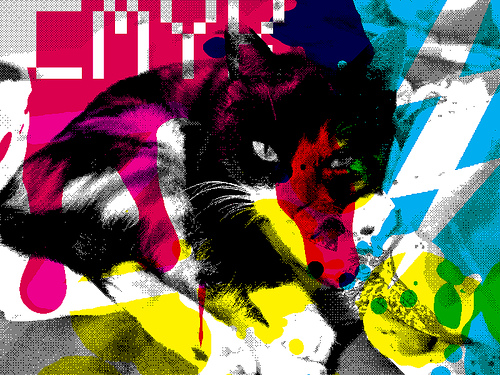
In the printing industry, to produce the varying colors the subtractive primaries cyan, magenta, and yellow are applied together in varying amounts. Before the color names cyan and magenta were in common use, these primaries were often known as blue-green and purple, or in some circles as blue and red, respectively, and their exact color has changed over time with access to new pigments and technologies.
Mixing yellow and cyan produces green colors; mixing yellow with magenta produces reds, and mixing magenta with cyan produces blues. In theory, mixing equal amounts of all three pigments should produce grey, resulting in black when all three are applied in sufficient density, but in practice they tend to produce muddy brown colors. For this reason, and to save ink and decrease drying times, a fourth pigment, black, is often used in addition to cyan, magenta, and yellow.
The resulting model is the so-called CMYK color model. The abbreviation stands for cyan, magenta, yellow, and key—black is referred to as the key color, a shorthand for the key printing plate that impressed the artistic detail of an image, usually in black ink.
In practice, colorant mixtures in actual materials such as paint tend to be more complex. Brighter or more saturated colors can be created using natural pigments instead of mixing, and natural properties of pigments can interfere with the mixing. For example, mixing magenta and green in acrylic creates a dark cyan—something which would not happen if the mixing process were perfectly subtractive.
In the subtractive model, adding white to a color, whether by using less colorant or by mixing in a reflective white pigment such as zinc oxide, does not change the color’s hue but does reduce its saturation. Subtractive color printing works best when the surface or paper is white, or close to it.
A system of subtractive color does not have a simple chromaticity gamut analogous to the RGB color triangle, but a gamut that must be described in three dimensions. There are many ways to visualize such models, using various 2D chromaticity spaces or in 3D color spaces.



 Purple Base Color - Tri-Color Representations
 Yellow Base Color - Tri-Color Representations
 Red Base Color - Tri-Color Representations
 Pink Base Color - Tri-Color Representations