Complementary Colors
Complementary colors are pairs of colors which, when combined in the right proportions, produce a neutral color; either white, grey, or black. When placed next to each other, they create the strongest contrast and reinforce each other. They are widely used in art and design. The pairs of complementary colors vary depending upon the color model, and how the color is made. In painting, which uses what are called subtractive colors, the traditional primary–secondary complementary color pairs, described since at least the early 18th century, were red–green, yellow–violet, and blue–orange. In the more accurate RGB color model, used to make colors on computer and television displays, red, green and blue light are combined at various intensities to make all the other colors. In this system, using what are called additive colors, the complementary pairs are red–cyan, green–magenta, and blue–yellow. In color printing, another system of subtractive colors, the colors cyan, magenta, yellow and black are used to produce all printed colors; the CMYK-system complementary pairs are the same as in the RGB system: red–cyan, green–magenta, and blue–yellow.
Complementary colors and the traditional color model
On the traditional color wheel developed in the 18th century, used by Claude Monet and Vincent van Gogh and other painters, and still used by many artists today, the primary colors were considered to be red, yellow, and blue, and the primary–secondary complementary pairs are red–green, orange–blue, and yellow–violet (or yellow–purple in Boutet’s color wheel).
In the traditional model, a complementary color pair is made up of a primary color and a secondary color (green, violet or orange). For example, yellow is a primary color, and painters can make violet by mixing of red and blue; so when yellow and violet paint are mixed, all three primary colors are present. Since paints work by absorbing light, having all three primaries together results in a black or gray color (see subtractive color). In more recent painting manuals, the more precise subtractive primary colors are magenta, cyan, and yellow.
Complementary colors can create some striking optical effects. The shadow of an object appears to contain some of the complementary color of the object. For example, the shadow of a red apple will appear to contain a little blue-green. This effect is often copied by painters who want to create more luminous and realistic shadows. Also, if you stare at a square of color for a long period of time (thirty seconds to a minute), and then look at a white paper or wall, you will briefly see an afterimage of the square in its complementary color.
Placed side by side as tiny dots, in partitive color mixing, complementary colors appear gray.
Complementary colors and the CMYK model
Color printing, like painting, also uses subtractive colors, but the complementary colors are slightly different than those used in painting. Color printing uses the CMYK color model, making colors by overprinting cyan, magenta, yellow, and black ink. In printing the most common complementary colors are magenta–green, yellow–blue, and cyan–red. Black is added when needed to make the colors darker.
Complementary colors and the RGB model
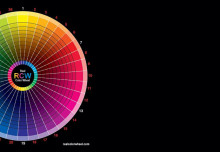
The RGB color model, invented in the 19th century and fully developed in the 20th century, uses combinations of red, green, and blue light against a black background to make the colors seen on a computer display or television screen. In the RGB model, the primary colors are red, green and blue. The complementary primary–secondary combinations are red–cyan, green–magenta, and blue–yellow. In the RGB color model, the light of two complementary colors, such as red and cyan, combined at full intensity, will make white light, since two complementary colors contain light with the full range of the spectrum. If the light is not fully intense, the resulting light will be gray.
In some other color models, such as the HSV color space, the neutral colors (white, greys, and black) lie along a central axis. Complementary colors (as defined in HSV) lie opposite each other on any horizontal cross-section. For example, in the CIE 1931 color space a color of a “dominant” wavelength can be mixed with an amount of the complementary wavelength to produce a neutral color (gray or white).
This Articles’ text is licensed under the Creative Commons BY-SA License since it partially uses material from Wikipedia.