

When you think of colors for kitchen appliances there are probably about three distinct colors that come to mind. These colors are black, white, (yawn) and stainless steel. Although these three colors are classics and do work well in almost any kitchen, they don’t exactly generate a lot of excitement. It seems that these days more and more people are breaking away from these traditional colors to create a more vibrant and unique look for their kitchen. Although colored appliances have been around for quite some time; it appears that we are starting to see a reemergence of colored appliances in the kitchen, and in a big way.
History of Colored Appliances in the Kitchen
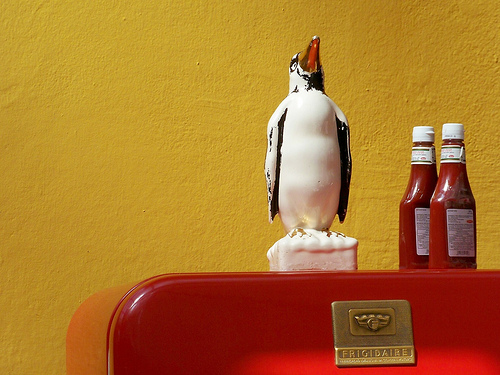
Although there has been a recent trend where we are seeing more colored appliances in the kitchen, the idea of infusing kitchen appliances with color is not a new one. Colored appliances began to show up in American kitchens as early as the 1950’s. There were actually quite a few different colors to choose from back in these days as companies offered colors like “Cadet Blue”, “Woodtone Brown”, “Petal Pink”, “Turquoise Green” and “Canary Yellow”. Many of these colors were not very popular and some did not have long lifespans, however two colors that were very popular and around for quite some time were “Harvest Gold” and “Avocado”.
Types of Appliances to Integrate Color With
Back when these first colored appliances started showing up in our kitchens, they were limited to, for the most part, refrigerators, stoves, and dishwashers. However, as technology has advanced manufacturers can now use color instruments to match the colors of different parts for different appliances more accurately. This, along with the recent trend back to color, has led to there being a wide array of colored appliances to choose from. While there are still larger colored appliances like dishwashers available, it is also possible to find smaller appliances like toasters or mixers.
When choosing colored appliances for your kitchen, it is important consider which type of appliance you want. This choice depends on a few different factors such as size and style of your kitchen as well as the color you are considering. Many people that have smaller kitchens tend to choose white for their bigger appliances as white seems to blend in more and make the kitchen look more spacious. However, if you have a larger kitchen which opens up into another room with many colors, large colored appliances can be used to tie the two rooms together from a decorative standpoint quite nicely. Also, if you desire a color that is on the bolder end of the color spectrum, such as a pink or purple, it may be wiser to purchase a smaller appliance with that particular color. This is because if trends or your taste change, it is much easier to replace a toaster rather than a refrigerator.
Choosing a Color
There are several factors to consider when choosing the color you want to go for. One thing to consider is your personal situation. For example, if you have a large family with young children you may want to stay away from darker colors black or blue as these colors will show scratches and dents more. It is also of course important to consider which colored appliance will complement the rest of the kitchen. This is the most important portion of this decision because, when done correctly, colored appliances can be integrated seamlessly into a kitchen to create a unique and vibrant space.
Utilizing colored appliances in the kitchen is all about finding the right color. Finding the right color for your appliances depends on a few different things such as personal situation, taste, and the design of your kitchen. When the right color is chosen, colored appliances offer an alternative to boring traditional appliance colors that adds style and personality to your kitchen.
Featured images:
 License: Creative Commons image source
Daniel Harris is a freelance writer currently working with BYK Additives & Instruments who develops devices for quality control through spectrophotometers. Through BYK Additives & Instruments, he has learned that there is a lot more to color than meets the eye and has forgotten more color codes than most people will ever learn.